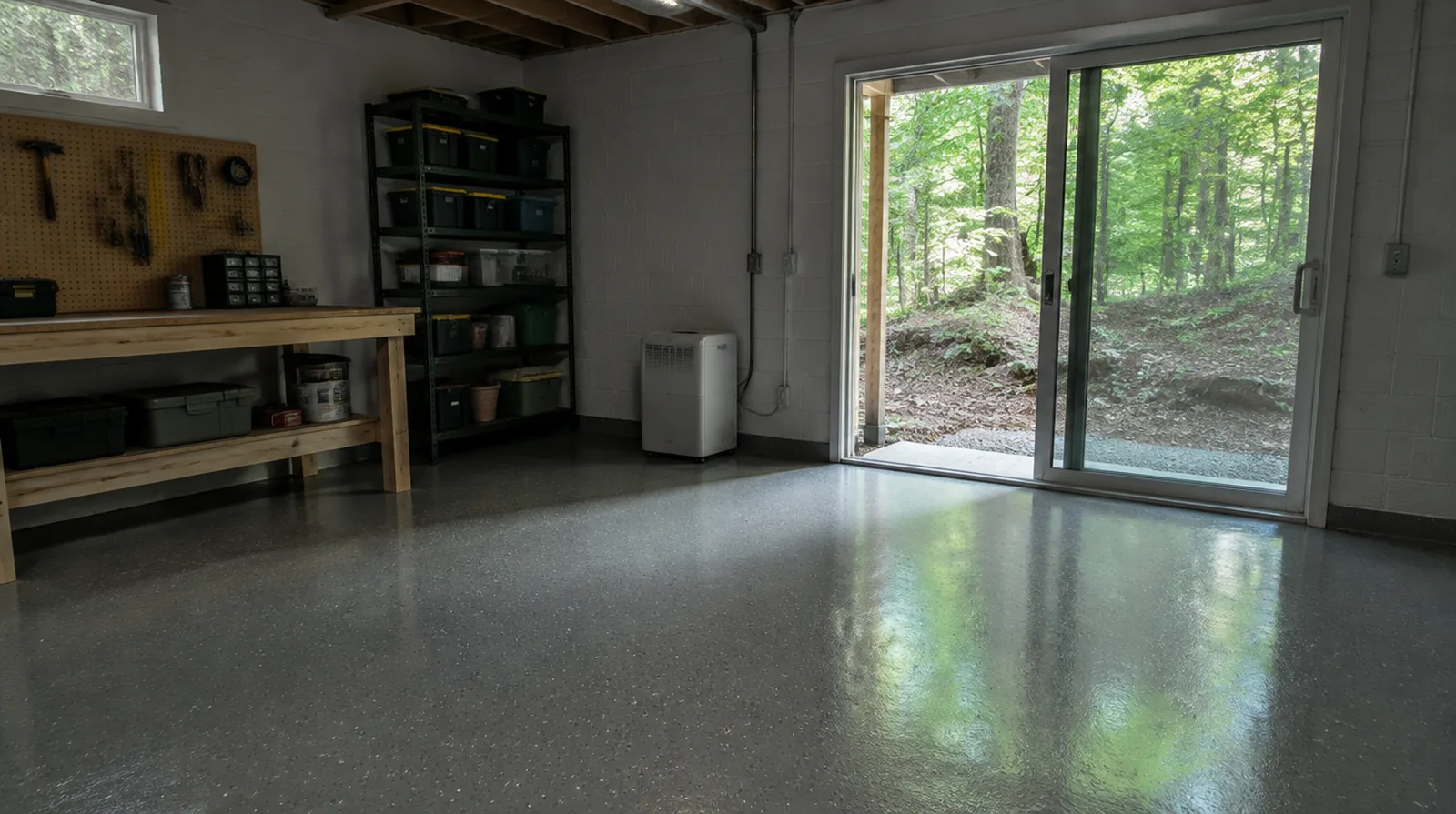
Basements in the Boston Mountains foothills
Alma sits where the Arkansas River valley starts to rise into the Ozark foothills, and the shape of the land decides who has a basement. Most homes in town sit on flat slabs, but houses built into hillsides often have a walkout lower level, and some older homes have a cellar or storm shelter dug into the ground. Those spaces get used for workshops, game rooms, hobby areas, laundry and storage, and almost all of them have a bare or painted concrete floor.
That floor has a harder life than a garage slab. It is in contact with the ground, and Arkansas ground holds water. Springs, heavy spring rain and clay soils that drain slowly can push moisture up through the concrete for much of the year, even when nothing looks wet.
Why moisture decides everything
A coating can only bond to concrete that is dry enough. If water vapor keeps moving through the slab, it can blister the coating, lift it from the surface or leave white mineral deposits under it. That is the main reason cheap hardware-store basement epoxy kits peel after a year or two.
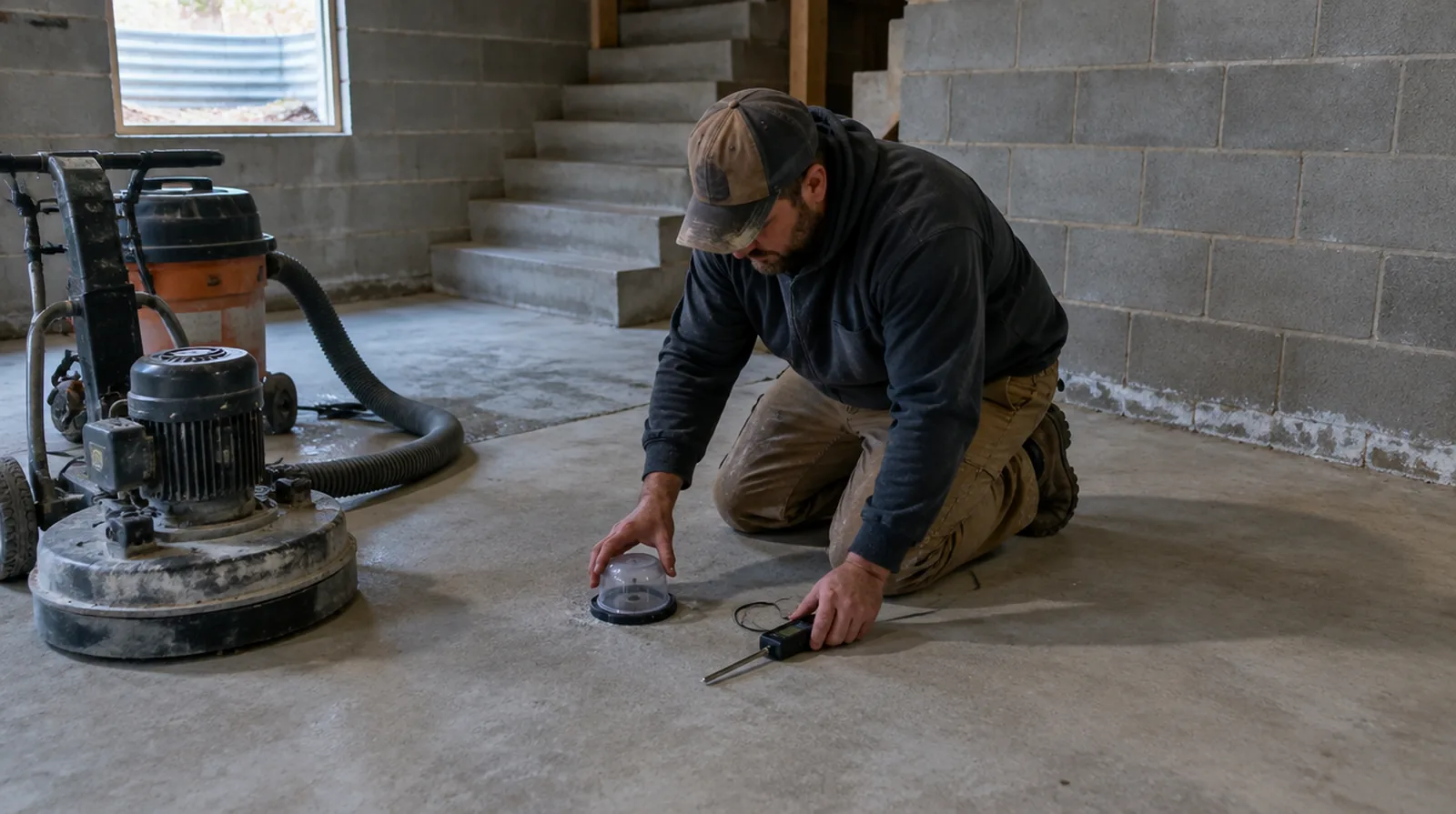
So we do not start with color. We start with testing:
- Calcium chloride or in-slab humidity readings measure how much vapor moves through the floor.
- A plastic sheet test shows if the slab is actively wicking water.
- A visual walk looks at the walls, window wells, downspouts outside and the grade around the house, which are the usual sources of the problem.
If the slab is too wet, we tell you why and what to fix first. Often, simple changes like extending downspouts, regrading near the wall or adding a sump or dehumidifier make the biggest difference.
The system we install
Grind and repair. We grind the concrete to open it up, remove old paint or sealers, and fill cracks, honeycombs and old anchor holes.
Moisture-tolerant primer. When readings call for it, we use a vapor-mitigating epoxy primer that blocks moisture before the color coat goes on.
Epoxy body coat. A solid-color or flake-broadcast epoxy adds thickness and strength. Flakes hide small imperfections and add traction on stairs and shop areas.
Clear topcoat. A urethane or polyaspartic topcoat guards against scuffs, chemicals and the yellowing that comes from window light. See our flake flooring and polyaspartic coatings for the options.
Living with a finished basement floor
Epoxy is seamless and easy to mop, which helps in a space that is damp and prone to dust. It resists oil, paint and cleaning products, and bright colors lighten a room that gets little sun. In a walkout space, the sliding door lets in daylight, so we usually recommend a UV-stable topcoat. For a basement bathroom or laundry area, we can add a textured finish for grip.
We also think about air. Fumes from a coating can linger in a closed lower level, so we use fans and open the walkout door while we work. Keep the room ventilated for a day or two as it cures. Furniture and heavy items can go back after about three days.
Storm cellars and shop spaces
Cellars and shelters have different needs: they need to be easy to clean, hold up to stored gear and not slip when wet. Epoxy with a light broadcast of grit works well. For a workshop or garage-style lower level, consider a heavier system like garage floor epoxy, which handles tools, jack stands and vehicles.
Best time to coat
Late summer and early fall are often the best times, when the ground is driest. Spring is the riskiest because the soil is saturated, so we test twice and give you time to see how the floor behaves. We do not coat below about 50 degrees or on a floor with active moisture.
Common questions
Can you coat a painted basement floor? Yes, after grinding off the old paint.
What if the floor sweats in summer? That is condensation from humid air on a cool slab. A dehumidifier and a proper coating can help, and we will explain it at the visit.
Do you serve nearby towns? Yes, including Van Buren, Mulberry, Dyer, Kibler, Cedarville and Fort Smith.
Find out if your basement floor is ready for epoxy
Call (479) 370-4896. We will test the slab and tell you what it needs before we quote.